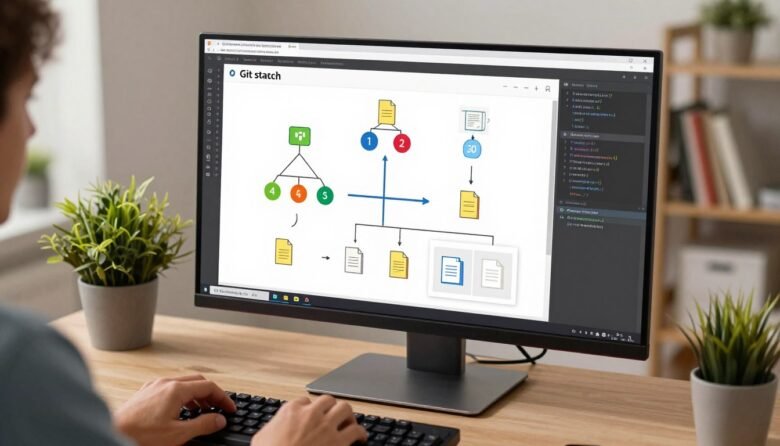
You are mid-refactor, half the tests are red, prod alerts flash, and your working tree is dirty. You need a clean checkout in minutes without losing your changes. This happened to me during a releases sprint and I learned to treat stash as a sharp tool, not a comfort blanket.
This short guide promises five specific techniques that cut risk in team repos where reviews and CI are non-negotiable. I point you to the official docs at git-scm.com for both git stash and git reflog as the source of truth. Remember: stash is local, not a remote backup.
Every trick below links to a failure mode you will see: wrong base, rebases, untracked junk, or forgotten entries. I also include exact commands you can run; a common quick move I use is: git stash push -u -m “wip: temp checkpoint”.
This piece assumes you ship code and care about traceability and reproducibility. Read on for intentional patterns that make this tool safe, and when a temporary commit is the better choice.
The real problem: you’re mid-refactor, prod is on fire, and your working tree is dirty
An urgent production bug forces you to pause a messy change and create a clean working directory to cut a hotfix branch. You can’t ship half-finished edits, but you also can’t abandon progress on the current feature.
Why “just commit it” is unsafe: if your branch policy requires every commit to be reviewable, a quick commit pollutes history. CI may gate on commit messages and audits can flag noisy commits. That makes traceability worse, not better.
Relying on git stash as your only backup is risky. Stashes live locally by default, so disk loss or a repo wipe can delete your progress. Branch switching via stash also leads to forgotten stashes or applying them on the wrong branch after a rebase. You end up with mismatched changes and muddled stashes.
- Need a clean branch fast without losing local changes.
- Avoid manufacturing review noise or CI failures with quick commits.
- Keep stashing short-lived, labeled, and fallback to a temp branch when risk is high for your team.
How stash actually works under the hood: working directory, index, and HEAD
You’re juggling partial edits while a high-priority bug needs a clean base now. Understanding what the system records helps you pick the safest move.
The core model is three states you touch: the working directory (what you edited), the index (what you staged), and HEAD (the commit you are based on). Each state is separate but linked when you run a snapshot command.
What it saves: index state vs working tree state
The snapshot records both the staged index and the unstaged working tree. That is why –keep-index preserves staged hunks while saving the rest.
Because staged and unstaged changes are stored as objects tied to HEAD, your saved set points back to the base commit that existed when you ran the command.
Why applies feel different from merges
When you apply a saved set, you’re replaying a delta onto whatever base you now have. This is not a branch merge; it’s an overlay of a past state onto the current HEAD.
- Map: working directory → index → HEAD to reason about what was recorded.
- Conflicts often mean the saved delta no longer matches the base commit, not just overlapping edits.
- Time and rebases increase drift; prefer a stash-branch if the base may move in history.
For precise behavior by version, check the official docs on stash internals and flags before you rely on automation.
When you should not use git stash
You need to jump to another branch fast, but your local edits are not ready to become a formal commit. In that case, don’t reflexively reach for a quick stash.
Branch switching WIP: prefer a durable WIP commit
If you need durability across machines or discoverability to teammates, a temporary commit is safer. You can push a WIP commit and later unwind it with git reset –soft. That preserves your changes and avoids forgotten entries.
Rebases and long-lived stashes cause pain
Long-lived stashes drift as branches rebase. Reapplying after unrelated history changes creates conflicts and time-consuming merges. Multiple stashes stack up as unlabeled state and become a liability when you try to reapply changes later.
- Don’t stash when you need cross-machine visibility or a reliable backup.
- A stack of unnamed entries makes reasoning about changes harder.
- If your branch will be rebased, use a temp commit or a dedicated branch instead.
Tie this to team policy: if main must stay clean but feature branches can be rewritten, WIP commits are often acceptable. The next section shows how to make searchable, identifiable stashes and a WIP alias approach.
Trick: Create stashes you can identify later with messages and context
When you must pause work and switch context, clear labels prevent lost checkpoints. Use a short habit that makes each snapshot searchable and obvious in the log.
Make messages your index
Always run the documented command with a message: git stash push -m “context”. An explicit message turns a nameless snapshot into a readable entry when you run git stash list.
Scope what you save
Stash only the paths that block your switch. Use pathspecs so other files and edits stay in the working tree and your snapshot has fewer conflict surfaces.
- Habit: prefer git stash push -m “context” over a naked stash command.
- Naming: WIP/<branch>/<ticket>: <intent> — e.g. git stash push -m “WIP/feature-auth/INC-214: refactor middleware (tests broken)”.
- Team rule: messages must include branch, reason, and whether the changes should reapply cleanly.
This convention makes git stash list read like a mini changelog. Scoped stashes reduce conflicts and cut the time you spend hunting the right entry or reapplying mismatched changes.
Trick: Stash only part of your change to keep your tests running
You want to run a focused test pass without committing unrelated edits that will pollute history. Use selective staging plus a keep-index snapshot to isolate the bits you intend to commit.
Stage the clean hunks, snapshot the rest
Step-by-step:
- Stage only reviewable hunks with git add -p.
- Run git stash push –keep-index -m “WIP: preserve experiments” to stash unstaged edits.
- Run tests against the staged state, then commit the passed changes.
- Run git stash apply (or pop) to restore remaining edits and continue development.
This works because the snapshot saves the working tree while leaving the index intact. The staged state becomes exactly what your next commit records, so test results map to a clean commit.
Failure mode: if you stage messy hunks, the keep-index snapshot preserves that sloppiness. Discipline in staging keeps commits reviewable and prevents noisy history.
Trick: Stash untracked files on purpose, not by accident
A hasty snapshot that pulls new files without review can turn a quick context switch into a security incident.
–include-untracked vs –all: what each flag grabs
Decide whether untracked items are intentional additions or noise. Use git stash push –include-untracked -m “WIP: add feature X” when the snapshot must carry new files you created.
Reserve –all for rare cases. That flag also pulls ignored artifacts like build output, IDE caches, and large binaries.
Secrets and build artifacts: how you poison a stash
Untracked items often include .env, API keys, or compiled artifacts. These bloat the repository object database and create a risk if you later commit or push those objects.
- Rule: fix .gitignore before you stash or commit untracked files during an incident.
- Rule: prefer include-untracked for deliberate new files; avoid –all unless you know every ignored file is safe.
- Rule: treat any local snapshot as sensitive—this tool keeps objects in the repo on your workstation.
Keep the goal simple: a clean working directory without smuggling junk. When in doubt, make a temp branch or update .gitignore first.
Trick: Use git stash branch to land a stash onto the right base
Turn local, nameless work into a visible branch so teammates can review and you can push it remotely.
Applying a saved set onto whatever branch is checked out is how you manufacture conflicts. The core fix is to recreate the base commit and replay the snapshot there. That keeps history clean and prevents wrong-base collisions.
How it helps
Using a stash branch creates a new branch at the commit where the snapshot was taken. Git then attempts to apply the snapshot on that base and, if successful, will drop the saved entry.
Step-by-step
- Create a branch from the stash: git stash branch wip/refactor-io stash@{2}
- Confirm the apply succeeded and run tests on the new branch.
- Break the changes into reviewable commits, tidy messages, and push the branch.
- Why this beats applying on your current branch: you avoid wrong-base conflicts and lost context.
- Benefit: your snapshot becomes a real branch with history and visible commits.
- Safety: if the apply succeeds, the original entry is dropped, so you reduce stash pile-up.
When you need to hand work off or back it up remotely, create a branch from the snapshot, clean up commits, and open a PR. That turns ephemeral state into a traceable piece of history your team can review.
Trick: Break a tangled refactor into reviewable commits using stash as a checkpoint
A tangled refactor that touches many files is hard to split with git add -p. Reviewers hate a single massive commit. Treat the final end state as a reproducible checkpoint and peel it into small, testable commits.
Replicable checkpoint loop
Stash the finished state once, then reapply and carve it into focused commits. That makes each change compile and pass tests before you move on.
- Run: git stash push –include-untracked -m “checkpoint: refactor end state”.
- Run: git stash apply to reintroduce the full changes, then edit files to create commit #1 that builds.
- Commit the narrowed change, then repeat apply and peel for subsequent commits.
Concrete example and conflict note
Toon Claes used a Go example: commit 1 adds a “whom” parameter, commit 2 injects a writer, commit 3 adds time-based greeting. Each commit compiles and is reviewable.
If you have multiple entries, use stash apply stash@{0} to target the checkpoint. Mid-series applies can produce conflicts because earlier commits change file shapes. Expect that and resolve carefully; the next section shows fast restore commands to recover from conflicts and keep progress moving.
Trick: Resolve stash-apply conflicts fast with targeted restore commands
If a stash apply produces conflicts, you may want the saved snapshot as your baseline so you can peel it into clean commits. This playbook is surgical: accept the snapshot across the working tree, clear the index, then re-stage intentionally.
Quick conflict playbook
Run the apply, then when conflicts appear do this:
- Accept the snapshot version in the working tree:
git restore --theirs .
- Clear staged conflict markers so you don’t commit partial merges:
git restore --staged .
- Now open files, make targeted edits, re-stage, and commit in small bites.
This sequence treats “theirs” as the stash. It works when your intent is to reset to the saved state and then edit, not when you need a careful manual merge of both sides.
After the restore, run your tests or compile immediately. You just forced a global resolution; validate the set of changes before pushing the branch or creating a checkpoint branch to continue the peel-and-commit process.
git stash workflow tricks for senior developers in a team repo
When time is tight, you need a decision framework that balances speed, auditability, and recoverability.
Stash vs commit vs branch: pick the least risky move
Assess constraints: protected branches, mandatory reviews, and audit trails change the safest option.
- If you need collaboration or backup, create a branch and push a WIP commit that teammates can see.
- If you need a quick local scratchpad and the work will be short-lived, a stash is acceptable.
- If a hotfix must ship immediately, clear a clean working directory, cut the hotfix branch, then restore changes.
Keeping traceability while staying fast
A pushed commit leaves breadcrumbs in the repository; a local stash does not. If an entry must survive a day or a laptop failure, convert it into a branch using git stash branch or a WIP commit you can push.
Adopt a team norm: short stashes only, name entries clearly, and prefer branches when durability or visibility matters. That reduces silent-loss risk and keeps audits sane.
The alternative workflow: temporary WIP commits you can push and later unwind
When you must leave a half-done feature and switch to urgent work, a disposable commit is a team-safe option. It turns your edits into a normal commit that you can push to the repository for backup and visibility.
Why Toon Claes recommends this for branch switching
Toon Claes prefers a WIP commit because it survives machine loss and is visible to teammates. A pushed commit is auditable in history and avoids lost checkpoints that happen with local-only snapshots.
Minimal commands and the unwind path
Quick steps you can run under pressure:
git add .git commit -m "WIP"- Switch branches and work on the hotfix or feature.
To remove the disposable commit but keep your changes locally, run:
git reset --soft HEAD~— this undoes the last commit and leaves your files staged and ready.
Practical aliases to save time
Drop these into ~/.gitconfig to make the pattern two keystrokes under pressure:
git config --global alias.wip '!git add -A && git commit -mWIP'
git config --global alias.unwip '!git reset --soft $(git log -1 --format=format:"%H" --invert-grep --grep "^WIP$")'
Hard rule: fix .gitignore before any WIP commit
Do not WIP-commit untracked files until your .gitignore is correct. Untracked files often include secrets or build artifacts. Once secrets enter history, cleanup is painful and disruptive to team development.
When you need to work something else, treat the WIP commit as disposable scaffolding. It is pushable, traceable in history, and less likely to be forgotten than a local-only snapshot.
Stash lifecycle management: list, apply, pop, and drop without losing work
When you return to paused work, treat your saved entries like a log you must read before acting. That habit cuts mistakes when multiple snapshots exist.
Run the list command and inspect each entry. Read messages and timestamps, and note the index shown as stash@{n}. This index is an explicit pointer into the stack.
Apply vs pop: choose safety
Prefer apply when you care about recovery. apply replays changes but keeps the entry so you can retry if conflicts occur.
Use a targeted command, for example: git stash apply stash@{2}. Do not assume the most recent entry is correct.
Delete with intent
Only drop an entry after you commit or move the changes to a branch. Use git stash drop stash@{n} to remove a specific item.
- Treat
git stash listlike a changelog you consult first. - Target entries by index to avoid replaying wrong sets of changes.
- Clear stale stashes regularly so your stack stays readable and supports a clean working state.
Safety nets: reflog recovery when you think you lost your stash or commits
If a recent operation seems to have swallowed your work, the reflog often shows where HEAD last pointed. This is the calm first step when a reset, pop, or drop leaves you unsure which commits survived.
Using git reflog to find “where HEAD went”
Run git reflog to list every recent HEAD movement. The command surfaces actions that do not appear in normal history, so you can spot the commit hash tied to your lost state.
Recover workflow: create a rescue branch from a reflog hash
Once you spot the hash, make it durable with a branch. For example:
- git reflog — identify the correct hash.
- git switch -c rescue <hash> (or git checkout -b rescue <hash>).
- Verify files and run tests, then push the branch to your remote repository if you need backup.
This works because reflog records reachable commit IDs even after history edits. Creating a branch anchors the state so it stops being floating in the reflog.
- Failure mode: you reset, popped, or dropped items during an incident and now can’t find work.
- Habit: check reflog before destructive experiments and create a rescue branch when in doubt.
Common mistakes mid-to-senior developers make with stashes
It’s easy to lose track of short-term saves and waste time rebuilding changes. Below are the frequent mistakes, why they happen, the cost, and simple habits to prevent them.
Forgetting a stash exists and re-implementing the same fix
What happens: you create a local snapshot, then return days later and start from scratch. Why: unnamed, long-lived entries are easy to ignore.
Cost: wasted time, duplicated changes, and divergent solutions across branches.
Preventive habit: name entries clearly, keep them short-lived, and run git stash list before starting related work.
Applying a stash on the wrong branch and manufacturing conflicts
What happens: you apply a saved state onto an unrelated branch. Why: fast context switches and unclear base commits.
Cost: avoidable conflicts and eroded trust in your local state.
Preventive habit: inspect the target branch, prefer git stash branch or create a rescue branch before applying.
Stashing during a rebase and expecting clean applies
What happens: you stash changes tied to pre-rebase commits. Why: rebases rewrite history and drift increases.
Cost: applies fail or require heavy conflict resolution.
Preventive habit: convert important snapshots into a temporary branch before rebasing.
Treating stash like a backup instead of a local scratchpad
What happens: you rely on local snapshots for durability. Why: convenience masks risk.
Cost: data loss on device failure and lost progress in critical cases.
Preventive habit: push a WIP commit or branch when durability and team visibility matter. Prefer apply over pop until you confirm the restore.
Reference points worth bookmarking (official docs and proven workflows)
Keep a short set of authoritative references so you can verify behavior quickly when an incident occurs. Bookmark the core docs and one or two deep dives that match your team policy.
Official Git documentation
Start with the Git SCM pages on git stash and git reflog. These pages explain flags, semantics, and recovery mechanics you must trust before automating commands.
Practices and platform notes
Read Toon Claes, Senior Backend Engineer at GitLab, on using WIP commits for safe branch switching and stash checkpoints to split large refactors. His guidance is practical and battle-tested.
- Bookmark the exact command patterns in this article: git stash push -m, –keep-index, –include-untracked, git stash branch, and the restore-based conflict steps.
- Add GitLab’s “15 methods to improve your Git-based workflow” as supplemental reading on aliases, pruning, and reset modes.
- Favor docs + proven posts over random snippets when you standardize team rules for a project.
These references give you the ability to validate commands and make the tool part of a repeatable project routine. Copy commands, test them against your repo, and record any team norms you adopt.
Conclusion
When a hot incident strips attention, you need a fast path to a clean working directory and a clear record of what you left behind.
Label and scope checkpoints, use keep-index for focused tests, include untracked files only when intentional, and convert important snapshots into a branch so teammates can see your changes. Use git stash and git stash apply only as short-lived local checkpoints, not long-term backups.
If an apply goes wrong, recover with the targeted restore playbook—git restore –theirs, clear the index, then re-stage and commit small pieces. Use reflog to rescue lost heads and push a WIP commit or branch when the work must survive time or rebases.
Final check before you leave: run git stash list or git log -1 so you know whether your state is a stash, a commit, or a branch. Do that and you avoid most lost time.

Spencer Blake is a developer and technical writer focused on advanced workflows, AI-driven development, and the tools that actually make a difference in a programmer’s daily routine. He created Tips News to share the kind of knowledge that senior developers use every day but rarely gets taught anywhere. When he’s not writing, he’s probably automating something that shouldn’t be done manually.